
RIP Carol Rumens

I’m very sad to learn that Carol Rumens has died. She was a long-time colleague of mine at Hull, where I remember meeting her and her husband Yuri at the station and embarking on a drive to the Royal Oak pub on the Humber estuary in Paull, amid much merry discussion of submarines, of all things, Yuri being a naval man. Much learned and convivial discussion followed over the years, and much collaboration on that long-running series of books on all things Hull we produced for Hull City Council. Just a few months ago I wrote to Carol suggesting she contribute to the Peter Didsbury birthday Festschrift I was coediting with Sean O’Brien. She responded almost immediately with the poem that has now appeared in that volume. I did not receive a reply when I sent her a proof though, and I now understand she had been taken ill in the interval. I salute her warm, wise and generous soul – a poet who always kept her nerve, as well as her optic nerve
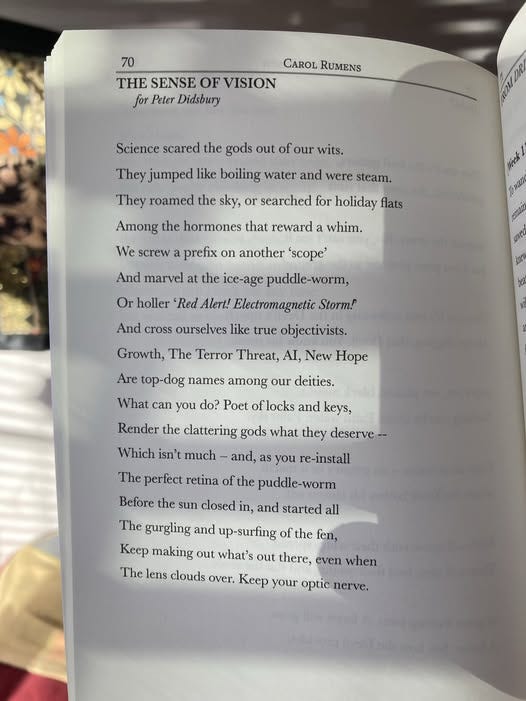
.
Fond memories of meeting her at that rainy Larkin conference we all assembled for in Hull once. This is a lovely poem for Peter D.
Carol Rumens formed a weird set of cloud shadows across my poetry seascape; I found her like a combination weed+edelweise peg that disnt quite fit into my various round or triangular holes. A couple of her poems were in my canon of all time greats; but I didn’t keep going back to her collections to get changed by them. She has inherited aspects or tonalities of the ‘Hull librarian-disease...grumpiness and disenchantment, which when easily voiced in epigram or epistle form tires quickly to my ear. She had an odd way of shifting gears from abstract to particular, and some of her insights were pedestrian. And then she’d take all of these flaws and make pure magic:
Jarrow
Nothing is left to dig, little to make.
Night has engulfed both firelit hall and sparrow.
Wind and car-noise pour across the Slake.
Nothing is left to dig, little to make
A stream of rust where a great ship might grow.
And where a union man was hung for show
Nothing is left to dig, little to make.
Night has engulfed both firelit hall and sparrow.
Most of these lines are both rhythmically polycandescent (so I guess that means that the rhythm of the shorter motif incandesces or presages the rhythm of the larger one). They also do something like the ‘periodic sentence’ but for rhythms. So if the periodic sentence doesn’t make sense until its end, the periodic rhythm is a form of amplification where the total effect of the beats is amplified by being combined, at the end. If you then add one of the six forms of rhyme it gets even more emphasised. Jarrow is a truncated/modified Villanelle, as intricate as an arabesque or an algorithm. ‘Night has engulfed both firelit hall and sparrow’ is a staggeringly brilliant compression of one of the pillars of mediaeval spirituality, where life or the spiritual journey is seen as a sparrow flitting through the Longhouse. The relics of industrialisation and political injustice add to the sense of meaninglessness. Its almost a poem that enacts the concept that poems cannot be written following the Holocaust, and yet, it is its own disproof. The beauty of it makes a mockery of nihilism.