
‘Dear Incomprehension’
Samuel Beckett's The Unnamable as Gnostic Gospel

Theology in Beckett often takes the form of preposterous scholastic puzzlers. There is Dum Spiro in Watt, editor of the Catholic monthly Crux, who reports a reader’s letter on the case of a rat which has ingested a consecrated wafer and wishes to know whether or not the animal has experienced the Real Presence. There are Jacques Moran’s questions from the second part of Molloy (‘Is it true that the infant St-Roch refused suck on Wednesdays and Fridays?’) – a small theological overflow of that character’s control-freakish pedantry. Often, these passages have been taken as evidence of Beckett’s exasperation with the palaeo-conservative absurdities of Free State Ireland. But the sheer scale of Beckett’s religious obsessions goes beyond that. In All That Fall, his religious sensibility matures into a deeper seriousness in the portrait of Maddy Rooney and her terminally obsolescent southern Protestant world, where the rector gives a sermon on ‘How to be happy though married’ and Maddy and husband Dan dissolve into mirthless laughter at the line ‘The Lord upholdeth all that fall and raiseth up all those that be bowed down’ from the Psalms. And then when we get to late Beckett there is the mysterious religious allegory of the twelve disciple-like ‘guardians’ in Ill Seen Ill Said.
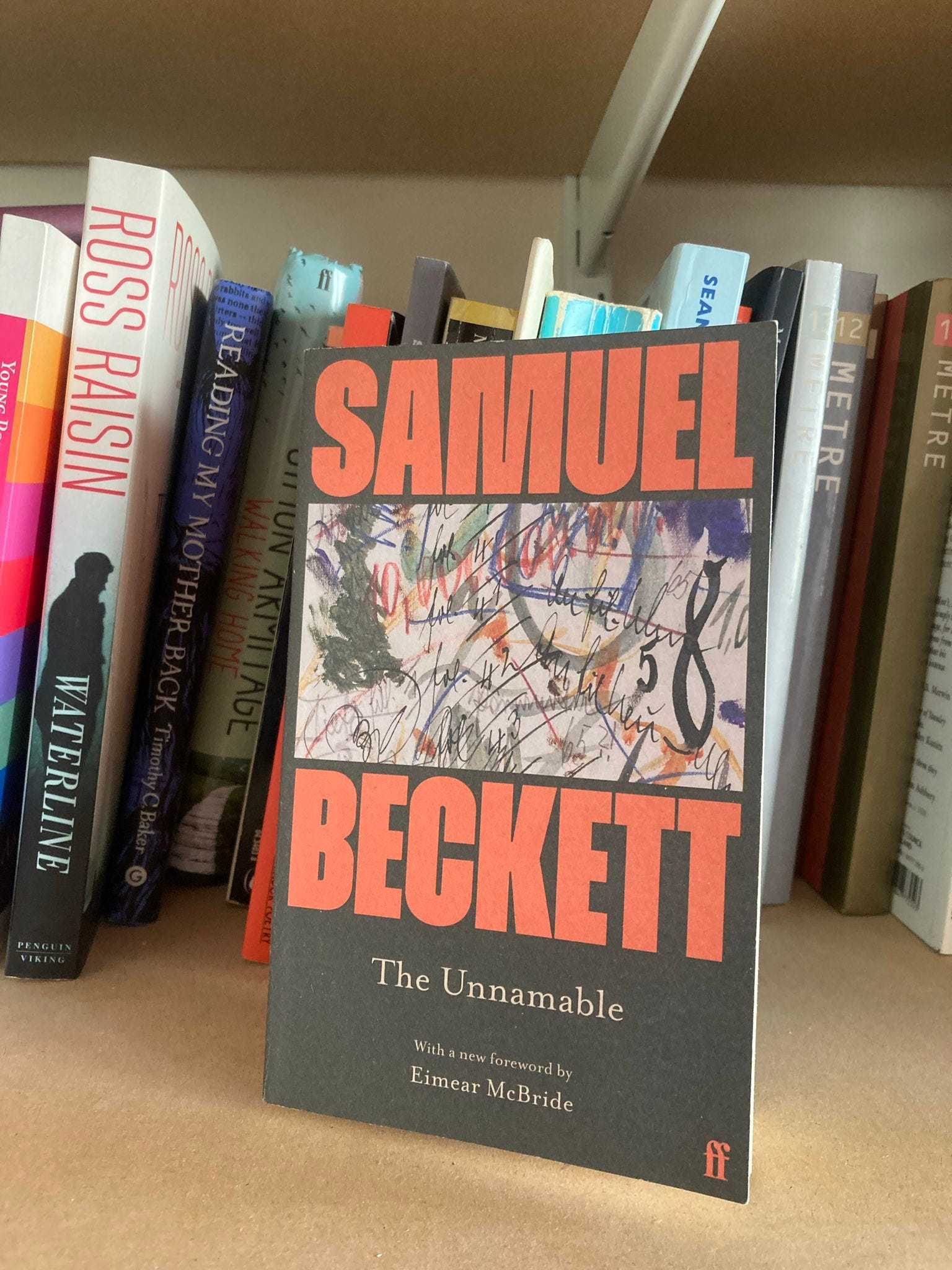
The text I have been rereading though is The Unnamable, whose composition dates from the postwar ‘siege in the room’ following an artistic revelation at Killiney harbour in 1946. As chance would have it, in December of the previous year a trove of Gnostic texts was found in Nag Hammadi in Egypt, and had The Unnamable been among them it would it would have fitted right in with only the smallest of adjustments, let me suggest. (On a side note, one unfortunate overlap with the gnostic gospels is textual corruption: I see a sprinkling of typos here, though thankfully nothing to compare to the run of pages embarrassingly missing from the 2010 edition.) A central obsession of the Gnostic texts is Christ’s physical body. In some texts, such as the Acts of John – in a salient instance of the Docetic heresy – he is an Obi Wan Kenobi-like hologram rather than a flesh and blood man. The effect of this is to spare Christ the agony of his death on the cross, an outcome the Gnostics could not countenance. What this Christ preaches is not salvation after death but the ascent to a state of enlightenment (‘gnosis’).
The Unnamable is a gnostic text in its rejection of embodiment. The speaker is a nothing, a no one, out of time and (most of the time) in no place. From the outset a philosophical vocabulary is deployed: ‘can one be ephectic [suspending judgement] otherwise than unawares?’ There is talk of the ‘Abderite’, and of the narrator’s ‘apodosis’. The gnostic donnée is distrust of the created world, but embodiment in his rump state, pondering the ‘unintelligible terms of incomprehensible damnation’, is all the Unnamable has. Physicality is a residue, an excremental discard from some higher order of existence. The higher state is alternately imagined as a realm of truth and release, or the abode of an imposter god/demiurge sometimes referred to as ‘Basil’. The longing for release can express itself in surprisingly messianic terms: ‘I am Matthew, and I am the angel, I who came before the cross, before the sinning, came into the world, came here.’ The important thing is to forswear any identification with the human. Any comparisons with Prometheus, he reminds himself (‘that miscreant who denatured fire and domesticated the horse, in a word obliged humanity’) are angrily rejected; in another miscarrying revolutionary comparison, he is a ‘kind of tenth-rate Toussaint L’Ouverture’. His tormenters, those ‘paltry priests of the irrepressible ephemeral’ and ‘fomenters of fiasco’, are keen to reconcile him to his fallen condition, which he compares to a ‘pensum’ (a favourite Beckett word), some manner of rote learning of the state of being human – an evolutionary narrative the Unnamable puts into reverse, longing instead for contraconception and the lucky release of a ‘dying sperm, in the sheets of an innocent boy’. If human he must be, it cannot be allowed to pass except as an absurd joke (‘it’s human, a lobster couldn’t do it’).
As ever in the three great novels capped by The Unnamable, everything divides into itself, and concerted efforts are made for the narrator to move his story forward as that of a character he calls Mahood, but whom he then discards for the next level again, named Worm. As he complains, he cannot die as Mahood, cannot be born as Worm. This passage of the novel is also enlivened by his use as a living (if you call that living) advertisement for a restaurant, on Paris’s rue Brancion. near a slaughterhouse, with a reference thrown in to the ‘hippophagist Ducroix’. One striking self-comparison is to a ‘billy in the bowl’, a nod to an eighteenth-century Irish beggar who propelled himself along in a bowl on wheels, from which position he was ideally positioned to cut passing purse-strings (cf. Lucky’s immiserated condition in Waiting for Godot, drawing Estragon’s sympathy, before Lucky lashes out and kicks him in the shins). Degeneration breeds a feral savoir-faire, rooting around in the gutter and surviving on scraps, but more than capable of baring its claws and turning on you, the reader moved to pity at the sorry spectacle.
What the above cannot convey, however, is the novel’s incredible, electric pace. If Molloy, Malone Dies and The Unnamable add up to a kind of concerto, Molloy is scored allegro con moto, Malone Dies largo maestoso, and The Unnamable presto prestissimo. As the tempo ratchets up, ever faster, towards the end, performative contradiction (‘the search for the means to put an end to things, an end to speech, is what enables the discourse to continue’) becomes almost instantaneous, in epic gasps of sentences, powered by torrents of commas. No proposition can be ventured without its opposite immediately tumbling out after it, absorbed into an all-neutering zone of ignorance that will ultimately run out of words and let whatever it is that lurks behind them show itself at last (‘dear incomprehension, it’s thanks to you I’ll be myself, in the end’). Negative theology indeed then, the gnostic dream in spit and sawdust. Impossible to read the final stretch of the text without hearing it voiced by Jack McGowan and Barry McGovern in their unforgettable performances of this most exhausting and beautiful novel. And the revelation at last, to borrow a phrase from Krapp’s Last Tape? I’m not sure there is one, which is to say, yes there will have been, somewhere speeding past (‘I won’t understand, but the thing will be said, they’ll have said who I am, and I’ll have heard, without an ear I’ll have heard, and I’ll have said it, without a mouth, I’ll have said it inside me, then in the same breath outside me…’), then receding to a remembered tremor in the fabric of existence, impossible beads of sweat left clinging to the desert sands.